
Why "we can't sell below the WOZ" is the most expensive assumption in Amsterdam real estate
The conversation we have almost every week starts the same way. The municipality's WOZ value is € 1,100,000; our substantiated advice is € 1,050,000. And the reaction, most often from our international clients, is instinctive: "But the municipality says it's worth 1.1 million. That's the floor, surely? We can't go below that."
To be fair, sometimes they're right. A home's market value often does land above its WOZ value, and in a rising market plenty of homes sell for more than the tax office says they're worth. That is exactly why the belief is so sticky. The trouble is the word always. What is often true gets treated as a rule, and it isn't one. The WOZ is not a minimum you have to sell above. It is a different number, built for a different purpose, that sometimes sits below market value, sometimes above it, and only by coincidence lands exactly on it. Treating it as a floor quietly costs sellers money.
A model that has never been inside your home
The municipality values every property in the city in one automated pass, using registered characteristics such as floor area, construction year and location, combined with recent sale prices in the area. Nobody walks through your home. The interior, the finish, the light and the state of maintenance are captured, if at all, as rough scores on a scale.
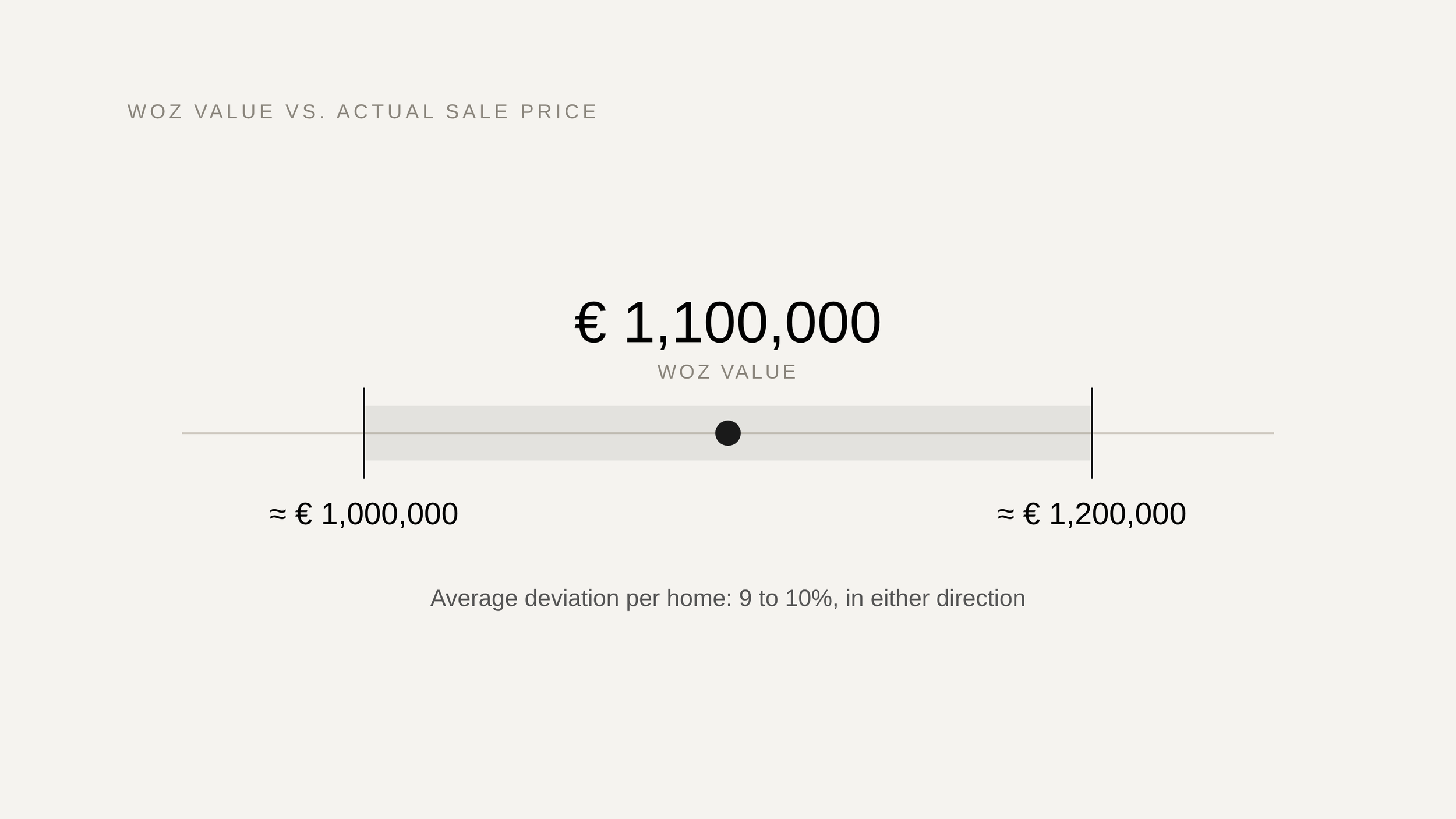
The largest study on this in the Netherlands, by the Waarderingskamer and the Land Registry, compared around 810,000 sales with the WOZ values of 8 million homes between 2012 and 2017. It reached two conclusions at once. On average, the model is remarkably accurate: no municipality systematically over- or undervalued homes. But for the individual home, the WOZ deviated from the actual sale price by roughly 9 to 10% on average. On a home with a WOZ value of 1.1 million, that is somewhere around € 100,000, in either direction. A figure that can be that far off, both ways, cannot serve as a minimum.
In Amsterdam, the WOZ is often meant to be higher
In Amsterdam there is a second factor that a national average doesn't show, and for many homes it weighs heavier. Article 17 of the Wet WOZ requires the value to be set as if full, unencumbered ownership changed hands and the buyer could move in straight away. In other words, the WOZ has to assume your home stands on freehold land and is vacant, even when it isn't.
A large part of Amsterdam is built on municipal leasehold land (erfpacht). Where an owner still pays an annual ground rent (canon), that cost genuinely lowers what buyers are willing to pay, but the WOZ is not allowed to take it into account. For those homes, a WOZ above market value is not an error. It is what the law prescribes. The effect is smaller where the ground rent has been bought off for a long period, and absent on freehold land, which is why a large gap on a freehold home deserves a closer look rather than a shrug.
The same applies to rented homes. The WOZ is a vacant-possession value, while a home sold with a sitting tenant typically fetches less. For owners selling a rented apartment, and there are many in Amsterdam right now, the WOZ can sit well above what the market will pay.
A snapshot of a market that has since moved on
Every WOZ value also has a statutory reference date (waardepeildatum), always 1 January of the year before the decision. The municipality needs that time to gather and analyse sale prices, so the number on your decision describes the market as it stood more than a year earlier.
Prices have moved since then, and that leads to an inference almost everyone makes: "the WOZ is over a year old and the market is up, so my home must be worth at least the WOZ, probably a bit more." But a rise in the market lifts your home's actual value. It does not lift the WOZ figure along with it. If the WOZ already sat above your home's real value on the reference date, as it does for many leasehold and rented homes, a modest rise still leaves your realistic sale price beneath it. In Amsterdam, recent growth has been modest. The increase starts from what your home was really worth, not from the tax figure.
The buyer's bank doesn't look at the WOZ
There is also a practical reason not to anchor on the WOZ, and it sits on the buyer's side. A buyer's mortgage is based on an independent valuation report, not on the WOZ. If a home is priced above market value because the WOZ suggests it, the valuation comes in lower, the buyer faces a gap they have to fund themselves, and the deal either falls through or gets renegotiated. In our experience, an asking price set by the WOZ rather than by the market usually means a longer listing and, in the end, a lower result.
[Voorbeeld uit de praktijk invullen: woning in ..., WOZ € ..., onze adviesprijs € ..., verkocht voor € ... na ... dagen.]
The municipality has no reason to inflate it
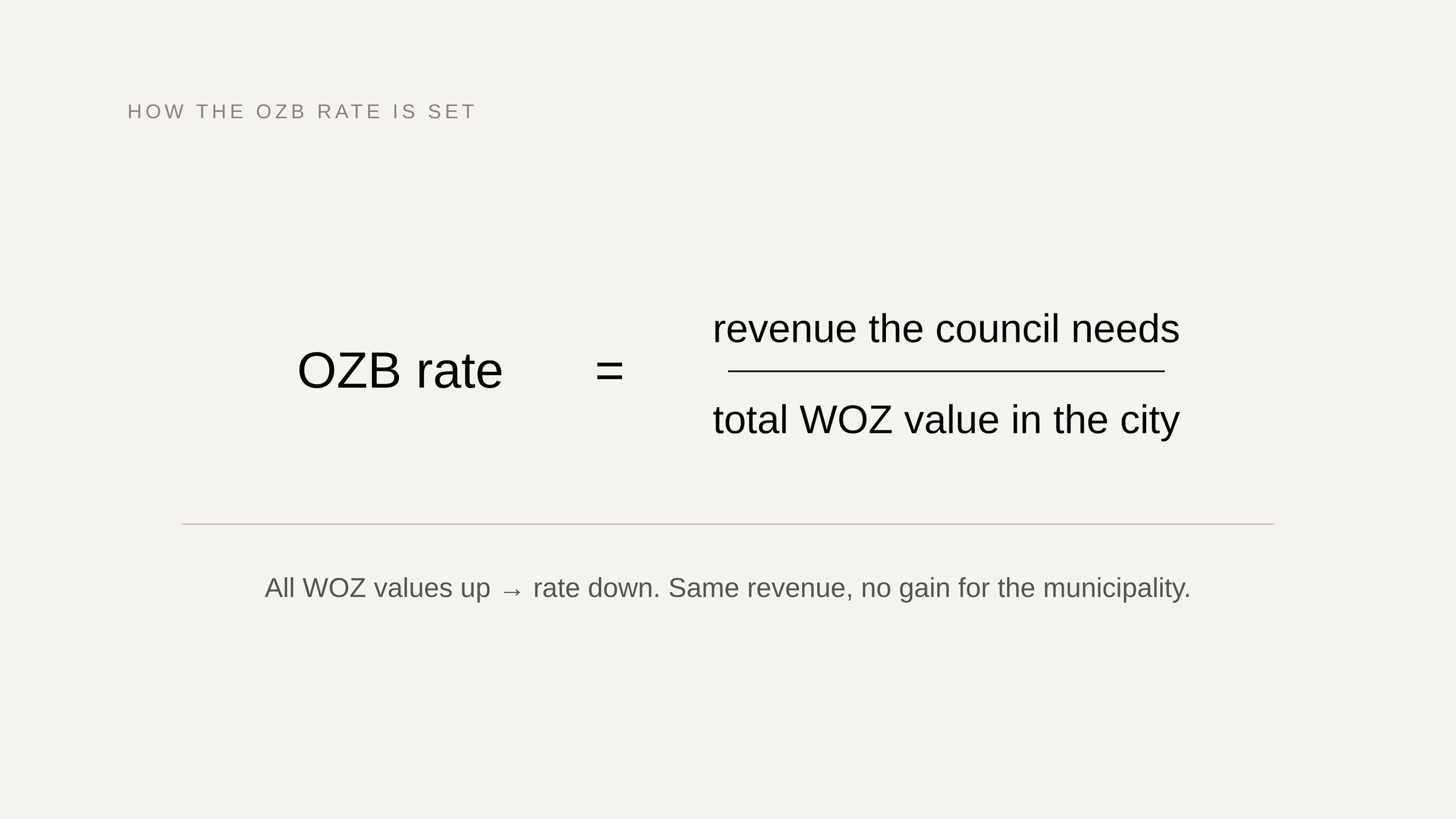
Some clients suspect the municipality inflates values to collect more tax. The arithmetic runs the other way. The property tax (OZB) rate is calculated by dividing the revenue the council wants by the total WOZ value in the municipality. If all values rise, the rate falls. A higher WOZ earns the municipality nothing in itself; a council that wants more revenue has to raise the rate, openly. Amsterdam illustrates it well: largely because its WOZ values are high, it has one of the lowest OZB rates in the country, less than a third of Groningen's.
How to actually use your WOZ value
In an ordinary open-market sale, selling below the WOZ is completely normal. There are two situations where the number does matter. In a sale to a family member, the tax authorities may treat a price well below market value as a partial gift. And for inheritance tax, the WOZ applies by law, even if the home is later sold for less.
If you think your WOZ is wrong, an objection (bezwaar) is most worthwhile when the registered characteristics are factually incorrect, such as the wrong floor area, the wrong construction year or an outbuilding that doesn't exist, or when the reference homes on the valuation report aren't genuinely comparable. You have six weeks from the date on the decision. Within that objection, you can also make a specific written request under Article 40(2) of the Wet WOZ for the figures behind the valuation, including the quality and maintenance scores assigned to your home. The municipality is obliged to provide them, and under settled Supreme Court case law, failing to do so in principle leads to a costs award. It is a small step that shows you exactly how your home was assessed.
A different measurement altogether
The WOZ value is good at the job it was built for: spreading a tax burden fairly across millions of homes. It is poor at the job people keep giving it, which is pricing one specific house. It describes a market from more than a year ago, comes from a model that has never been inside your home, and in Amsterdam it is often required by law to sit above what buyers will pay. So it is not a floor, and it is not a ceiling either. The moment you use it to set an asking price, you let a tax figure negotiate on your behalf. Pricing a home on the market, not on the tax office's estimate, is exactly what we're here for.